If you’ve been staring at an overgrown pasture, a wooded lot that needs opening up, or a ranch tract that’s turned into a brush thicket, there’s a good chance someone has said the words “forestry mulching” to you. It’s one of the most efficient ways to clear land — but the first question almost everyone asks is the same one: how much does forestry mulching actually cost?
Fair question. This guide breaks down forestry mulching cost in plain English — what you can expect to pay per acre, the factors that move the price up or down, and why, for most landowners, the per-acre number ends up being the cheapest part of the job when you look at the full picture.
| Quick AnswerForestry mulching typically costs $300 to $1,500 per acre in most of the United States, with the sweet spot for moderately overgrown land landing between $500 and $1,000 per acre. Pricing is driven by vegetation density, tree size, terrain, and access — not square footage alone. The benefits — no hauling, no burning, improved soil, and 5–10x faster completion than traditional clearing — are why most landowners come out ahead even on the higher end of that range. |
What Is Forestry Mulching?
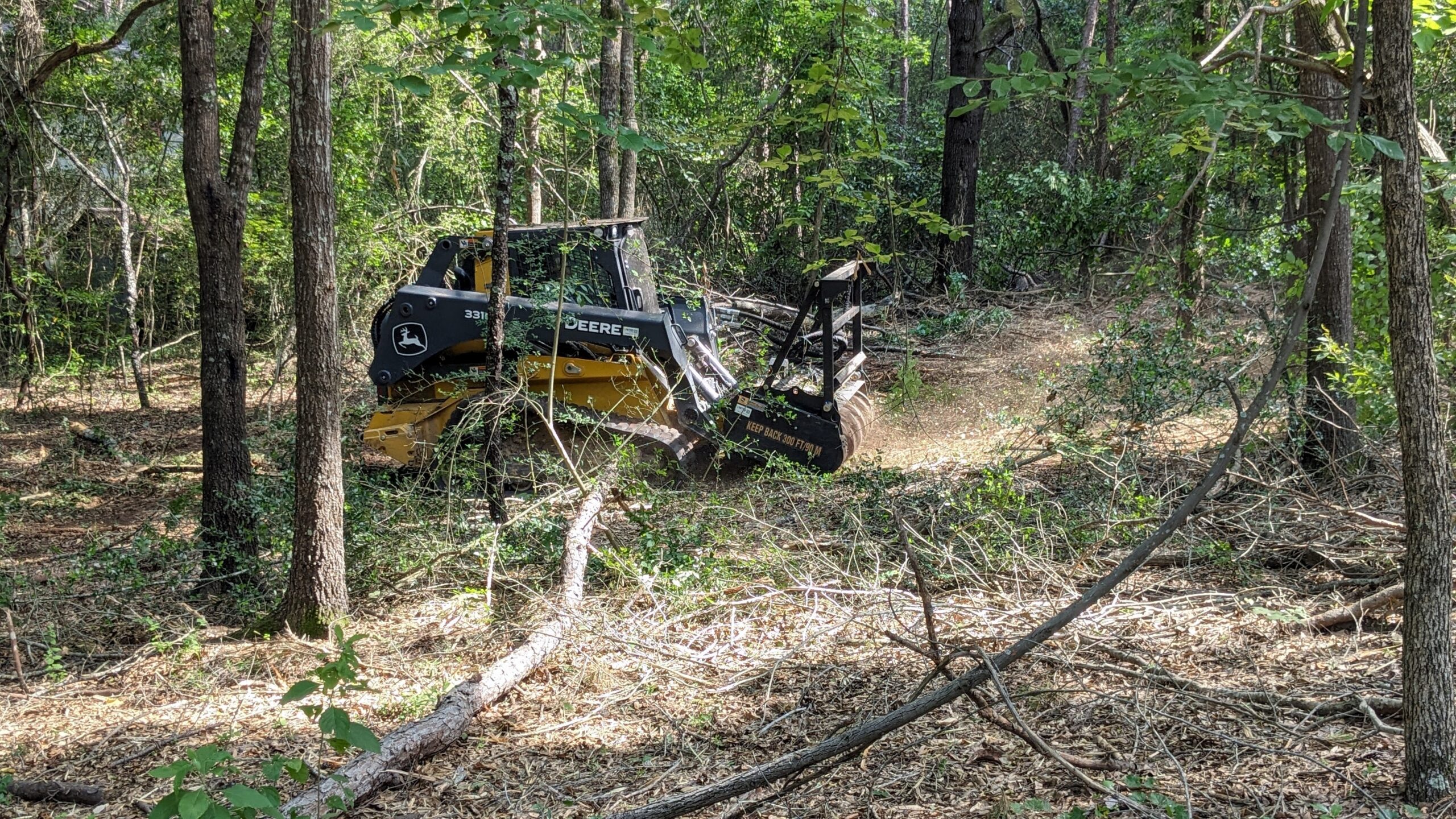
Forestry mulching is a one-pass land clearing method that uses a high-horsepower machine — typically a skid steer or excavator fitted with a mulching head — to grind trees, brush, vines, and undergrowth directly into the soil. Everything stays on site as a mulch layer. No burn piles. No hauling. No follow-up cleanup crew. If you’re new to the topic, our forestry mulching service page walks through exactly what the process looks like in the field.
How Much Does Forestry Mulching Cost Per Acre?
Most forestry mulching jobs are priced per acre, though some contractors quote by the hour or the day for smaller parcels. Here’s what typical per-acre pricing looks like across the U.S., based on vegetation density:
| Vegetation Density | Typical Per-Acre Cost | What You’re Looking At |
| Light brush | $250 – $500 | Sparse saplings, tall grass, light undergrowth — minimal trees |
| Moderate | $500 – $1,000 | Mixed brush and small trees up to 4–6 inches in diameter |
| Heavy | $1,000 – $1,800 | Dense brush, mature underbrush, trees 6–10 inches in diameter |
| Very heavy / vine-choked | $1,500 – $2,500+ | Thicket conditions, larger trees, heavy vine networks |
These ranges are a starting point, not a final quote. The actual forestry mulching price per acre on your property depends on a handful of specific factors that we’ll break down next.
What Affects Forestry Mulching Price Per Acre?
1. Vegetation Density and Tree Size
This is the single biggest driver. A mulching head can grind through brush and small trees quickly, but every additional inch of trunk diameter slows the machine down and increases wear on the teeth. An acre of light brush might take 90 minutes. An acre of mature oak saplings and cedar can take a full day. Same acre — different price.
2. Terrain and Slope
Flat, dry ground is the fastest and cheapest to mulch. Steep slopes, wet bottomlands, rocky soil, and sensitive terrain around creeks or drainage features all slow the work down and sometimes require different equipment or a different approach. Expect a modest premium for challenging terrain.
3. Access to the Property
If a skid steer can drive right onto the property from a road or driveway, you save money. If the crew has to build temporary access, haul equipment a long distance across private roads, or navigate gates and fence lines, that adds to the per-acre number.
4. Job Size
Economies of scale apply. A 10-acre job will almost always come in at a lower per-acre rate than a single-acre job, because mobilization (getting the equipment to and from your property) is a fixed cost spread over more acres. If you have a small job, expect a minimum charge — typically a half-day or full-day rate.
5. Selective vs. Full Clearing
Some landowners want every stick on the ground ground up. Others want selective work — leave mature hardwoods, clear everything under 4 inches, preserve fence-line trees. Selective work takes more time and operator skill, which can push the price up slightly.
6. Regional Rates
Forestry mulching cost varies by region. The South and Midwest tend to run a bit below national averages because there’s more competition and more acreage being cleared. Coastal and mountain-region pricing runs higher. Fuel prices and local labor costs both factor in.
Benefits of Forestry Mulching (Why the Per-Acre Cost Is Worth It)
On paper, forestry mulching isn’t always the cheapest clearing method by the hour. Where it wins — by a wide margin — is on total project cost and long-term land health. Here’s why landowners keep choosing it:
1. No Haul-Off, No Burn Piles
Traditional clearing methods cut the vegetation, then pay another crew (and often another machine) to haul debris off-site or burn it. That’s a second line item most quotes don’t include. Mulching does it in one pass — the vegetation becomes mulch right where it stood. You pay once.
2. Faster Completion
A forestry mulcher is, acre for acre, one of the fastest clearing methods available for brush and small-to-medium trees. Jobs that would take a bulldozer crew a week can be done in a day or two.
3. Better for the Soil
The mulch layer left behind protects the topsoil from erosion, holds moisture, and slowly decomposes into organic matter. Bulldozing, by contrast, strips and compacts the soil. If you plan to use the land for pasture, gardens, orchards, or anything that grows, mulching leaves the ground in much better shape.
4. Less Impact on Mature Trees You Want to Keep
Mulching is surgical. You can clear understory and invasives without disturbing mature trees, fence lines, or nearby structures. Traditional clearing often damages what you wanted to save.
5. Lower Regrowth vs. Cutting Alone
Because mulching grinds vegetation to ground level (and into the ground), regrowth is slower and weaker than with a standard brush hog. For most species, a single mulching pass buys you several years before any real follow-up is needed.
6. Works in Sensitive Areas
Near creeks, wetlands, and septic fields, mulching is often the only option that’s both effective and compliant. The light footprint of a tracked skid steer and the lack of exposed soil make it friendly to sensitive terrain.
When Is Forestry Mulching Worth the Cost — and When Isn’t It?
- Forestry mulching is the right tool when:
- You have meaningful acreage (1 acre or more)
- The vegetation is mostly brush and trees under 10–12 inches in diameter
- You want to keep the soil protected and the land usable right away
- You don’t want to deal with debris removal, burn permits, or cleanup
- The terrain allows skid-steer or excavator access
It’s probably not the right tool when:
- You have mostly large mature trees that need to be felled and removed whole
- You need stumps fully extracted (mulching grinds to ground level, not below)
- The job is very small — under a quarter acre — and a chainsaw would do
- You need topsoil moved or a finished grade (that’s land grading territory)
If your job is a mix, the right move is usually a combined approach — forestry mulching for the bulk of the acreage plus targeted land clearing for anything outside the mulcher’s sweet spot.
How to Get an Accurate Forestry Mulching Quote
Published per-acre rates will give you a ballpark. A real quote requires a property walk. Here’s what a good contractor will want to know — or see in person — before giving you a firm price:
- Total acreage to be cleared (with approximate boundaries)
- Vegetation type and density (photos help)
- Largest tree size you want mulched
- Whether you want full clearing or selective work
- Property access (road frontage, gates, easements)
- Any sensitive features — creeks, septic, buried utilities, structures
- Timeline — one-time job or recurring maintenance
Most reputable crews will drive out for free, walk the property with you, and give you a written estimate. If a contractor refuses to walk the site before quoting, that’s a signal to get a second opinion.
Forestry Mulching Cost FAQs
Q: What is the average cost of forestry mulching?
A: Nationally, the average cost of forestry mulching falls between $500 and $1,000 per acre for moderately overgrown land. Very light jobs can come in as low as $250–$400 per acre, and heavy, vine-choked, or steep terrain can run $1,500–$2,500 per acre. Most landowners should budget around $750 per acre as a planning figure.
Q: Is forestry mulching cheaper than traditional land clearing?
A: For brush and small-to-medium trees, yes — usually significantly. Traditional clearing has hidden costs: debris hauling, burn permits, stump grinding, and topsoil repair. Forestry mulching rolls all of that into one per-acre price. Where traditional clearing wins is on very large mature trees that need to be felled whole.
Q: How long does a forestry mulching job take per acre?
A: A light acre can take 1–2 hours. A moderately wooded acre typically takes 3–5 hours. Heavy, dense acreage can run 6–10 hours or more. Total project time also includes mobilization, breaks for maintenance, and any selective work.
Q: Can I mulch just part of my property?
A: Yes. Partial and selective clearing is one of the strengths of this method. You can keep fence-line trees, mature hardwoods, and shade trees intact while clearing everything underneath.
Q: Does forestry mulching kill the roots?
A: Mulching grinds vegetation at or just below ground level. For most species, this significantly disrupts regrowth, but invasive or stubborn species — cedar, yaupon, some briars — may send up new growth over time. Periodic maintenance keeps those in check.
Get a Free Forestry Mulching Estimate
Pafford Land & Home provides forestry mulching services throughout Gilmer, TX and across Northeast Texas — including Longview, Marshall, Mount Pleasant, Gladewater, Kilgore, and the surrounding 40-mile radius. Every project starts with a free on-site walk-through, a clear scope, and a written per-acre price before any work begins. No surprise line items. Ready to talk numbers? Request a free estimate or call (903) 402-7121.